
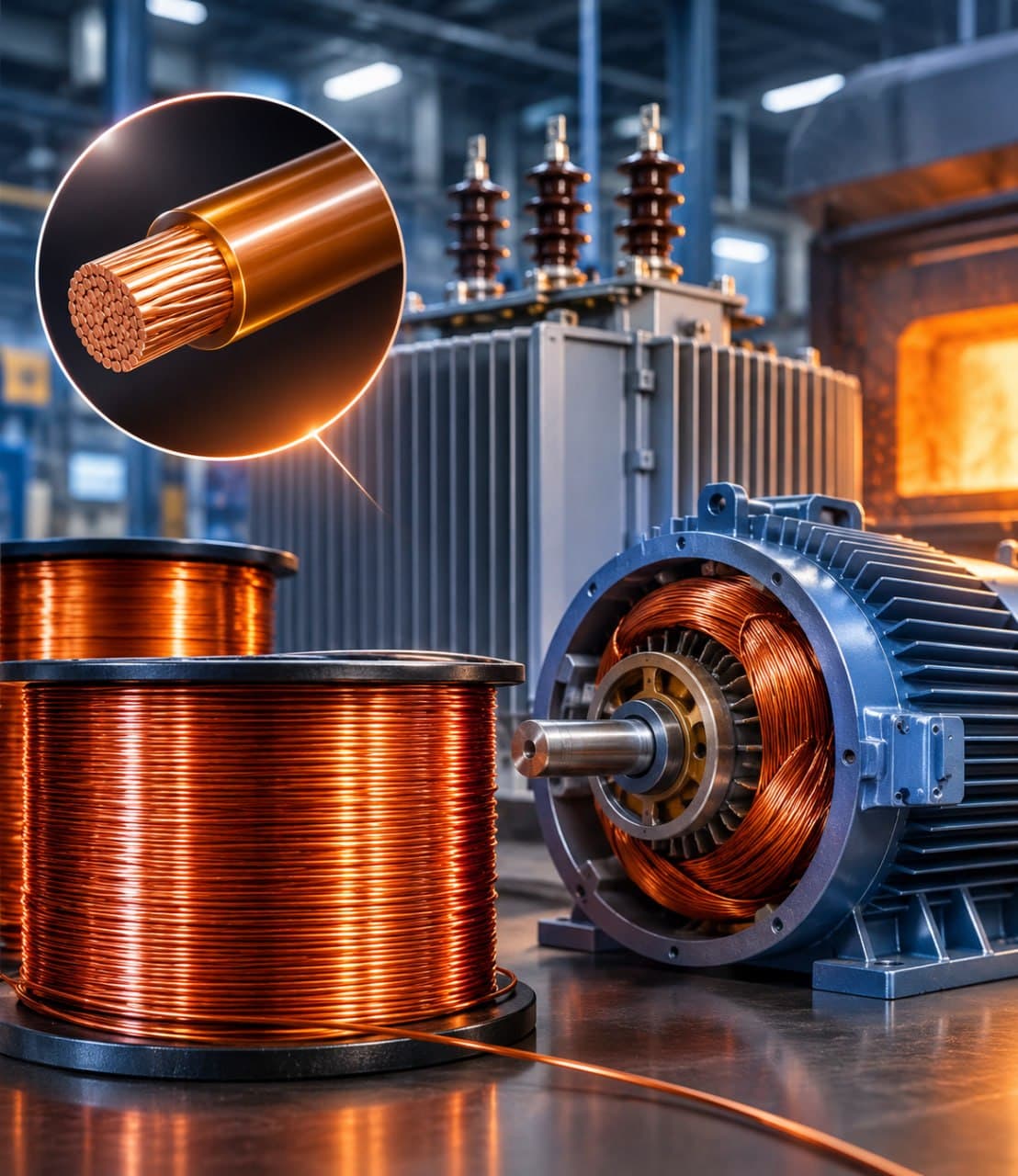
Why Do Motor and Transformer Windings Burn Out? The Engineering Behind Fenitec 220°C Enameled Wires
In the manufacturing and rewinding of industrial electric motors, welding machines, and power transformers, the leading cause of equipment failure is winding overheating and turn-to-turn short circuits. While voltage fluctuations are often blamed, the root cause is frequently an under-rated magnet wire insulation class.
Enameled copper and aluminum winding wires manufactured by FENITEC (such as PETD-200 / Class 220) are engineered to withstand continuous operating temperatures up to 220°C. This exceptional thermal endurance is achieved through an advanced dual-coat enamel insulation system. Explore our full range of winding wires in our catalog.
Dual-Coat Chemistry: Polyesterimide + Polyamide-Imide
Unlike conventional single-coat magnet wires, Fenitec conductors are coated sequentially with two specialized, complementary high-temperature polymer resins:
Base Coat — Polyesterimide (PEI): Ensures maximum chemical adhesion directly to the copper or aluminum conductor core while providing superior dielectric strength against high-voltage surges.
Top Coat — Polyamide-Imide (PAI): Acts as a rugged outer shield, delivering extreme thermal endurance (up to 220°C), immunity to transformer oils and chemical varnishes, and superior surface abrasion resistance.
This dual-layer synergy guarantees outstanding mechanical flexibility—preventing crazing, cracking, or flaking during high-speed automated coil winding and tight stator slot insertion.
Why Standard Polyurethane Insulation Fails Under Heavy Loads
Lower-cost wires coated with standard polyurethane (PEW / UEW) are designed primarily for low-power relays and light consumer appliances. Using them in heavy industrial motors or transformers creates severe reliability risks:
Low Thermal Threshold: Polyurethane begins to soften above 130°C–155°C, rapidly losing its dielectric insulation barrier.
Limited Mechanical Toughness: High winding tension and continuous electromagnetic vibration easily abrade and fracture polyurethane films.
Costly Equipment Downtime: Even brief current overloads cause rapid thermal breakdown, leading to complete winding burnout and expensive repairs.
Key Advantages of Fenitec High-Temperature Magnet Wires
Verified 220°C Thermal Margin: Protects your equipment against thermal overload in harsh industrial environments, multiplying operational lifespan.
Superior Bend & Abrasion Resistance: Maintains 100% insulation integrity across complex coil geometries.
Strict Laboratory Certification: Every production spool undergoes rigorous testing for breakdown voltage, thermal shock endurance, and film concentricity according to international quality standards.
Fenitec — uncompromising quality in every winding!
Looking for certified 220°C dual-coat enameled winding wires directly from the manufacturer? Contact our sales team below — our specialists will reach out to you shortly!